To enquire about a guest lecture or kanji workshop, visit Contact Us.
Natalie Cumming Hamilton studied Japanese in high school in Sydney. However, despite having loved the language, she dropped it for the Higher School Certificate, fearing that she would not be able to learn the large amount of kanji required (at the time, around 1000 characters).

She went on to complete a Bachelor of Communication (film and writing majors) at the University of Technology Sydney, and has worked as a writer and educator many years. In 2004 she followed her dream of learning a foreign language, moving to rural Oita Prefecture in Japan to teach English on the JET Programme, a grass-roots international exchange program. She stayed for three and a half years and while there not only fell in love with the people and culture, she realised she loved teaching and became fascinated with kanji characters.
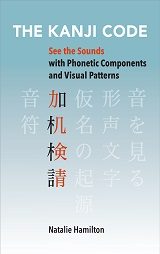
Mostly studying independently outside mainstream education, she embarked on intensive kanji study for the Japanese Language Proficiency Test and the Kanji Kentei – a kanji test that is usually taken by Japanese learners. It was during this study that Natalie realised how helpful phonetic components and visual patterns were when learning kanji ON readings. As a result of this knowledge, her Japanese reading skills improved dramatically. Natalie wrote The Kanji Code textbook as a way to share what she learned in a simple and accessible form with other students of Japanese.
When she returned to Australia Natalie began a Master of Translating & Interpreting at Macquarie University, while working as a Translator at Fujitsu. She later worked as a Technical Writer of elearning materials at a global automotive software company. Upon graduation, she attained NAATI Certification for Professional translation from Japanese to English, and worked in freelance translation for several years. During this period she translated content for companies including MUJI, ANA and Sony. She specialized in software localisation and marketing translation or ‘transcreation’, and especially enjoyed translating social science academic papers. She was employed as a casual academic at Western Sydney University from 2018-2020, where she taught Translation Technology, Text Analysis for Translation and Translation Practicum.
In 2018, she revisited a linguistics dissertation she had written during her translation studies. She formalised the patterns she had observed and collated lists of example kanji, components, radicals and vocabulary. She used her experience as an educational writer to create a user-friendly, easy to read guide to memorizing kanji ON readings. The Kanji Code was published in February 2019. While promoting the book, Natalie was inspired to begin a Master of Teaching to deepen her knowledge of kanji learning pedagogy. In 2022 she was awarded a Dean’s List prize for academic excellence from the University of New South Wales (UNSW). She holds teaching codes in Japanese, English and English as an Additional Language or Dialect (English as a Second Language) and is currently employed as a teacher in Sydney, Australia.
 The Kanji Code